
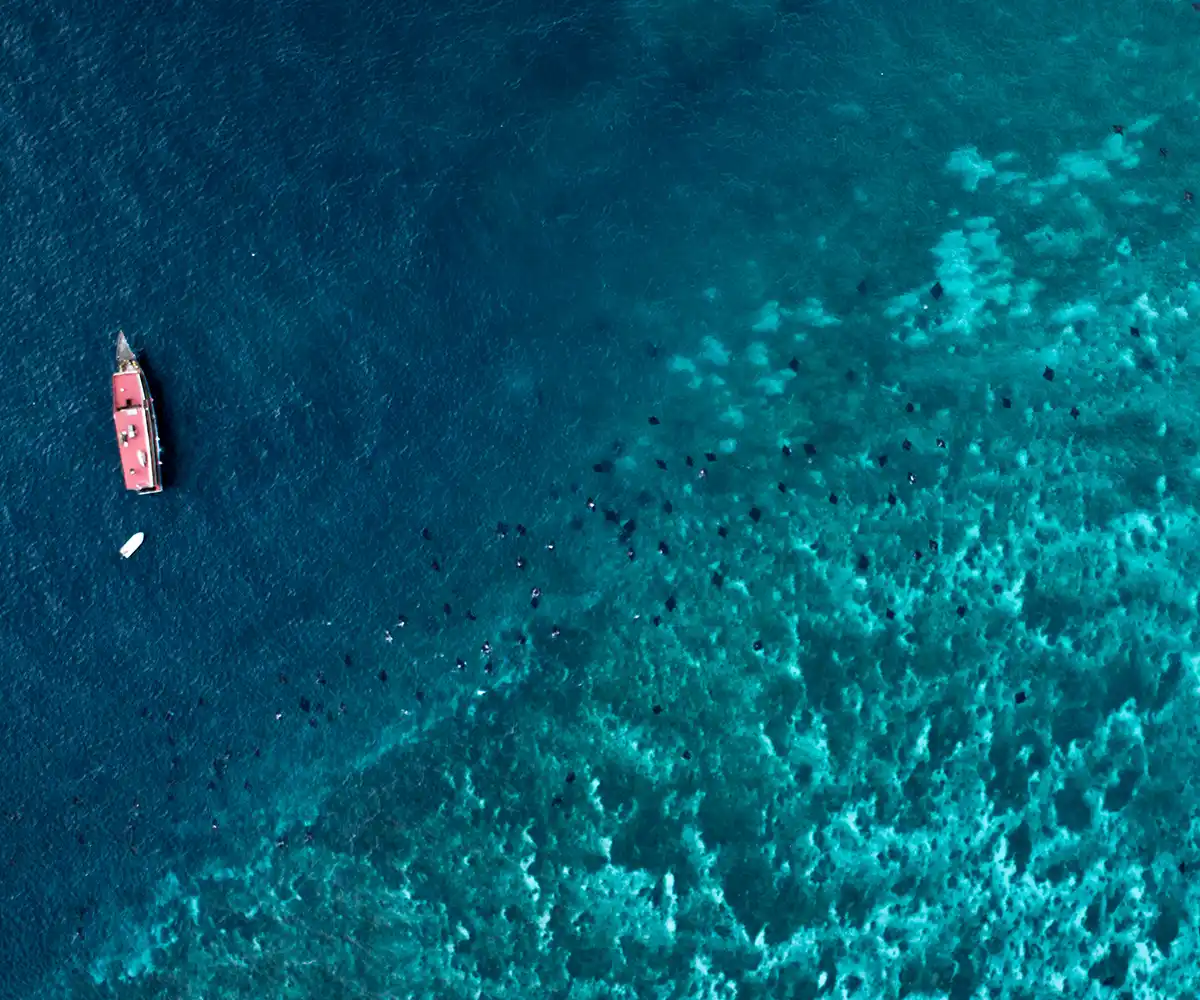
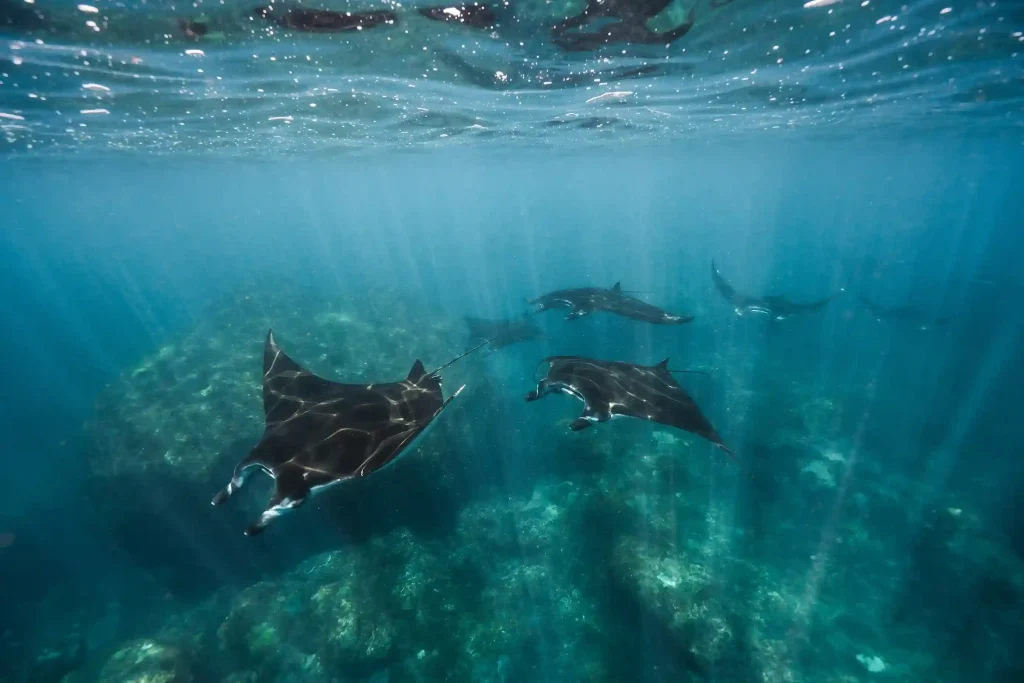
Reef mantas are seen at Manta Point (Karang Makassar) in Komodo throughout most of the year whenever the current is running, so there is no closed season. Sightings are most consistent in the dry months of roughly April to October, while the southern site Manta Alley peaks around October to December.
Is there a manta season in Komodo at all?
Not in the way people expect. Reef mantas in Komodo are resident rather than migratory in any strict sense, and the aggregation site most visitors go to – Karang Makassar, universally called Manta Point – is a long, shallow, current-swept channel where mantas come to feed on plankton and to be cleaned. Whenever the tide pushes plankton-rich water through that channel, mantas have a reason to be there.
That is why an honest answer to ‘what month should I come for mantas’ is ‘almost any, but come on a boat that can wait for the right tide’. What actually changes month to month is the sea state, the visibility and how comfortable the drift is, not whether the animals exist.
| Months | Sea and weather | Typical visibility | Manta outlook | Crowds |
|---|---|---|---|---|
| January–March | Wet season, rain and swell, some trips cancelled | Around 10–20 m | Mantas still present; access less reliable in rough weather | Lowest |
| April–May | Shoulder, seas settling, islands still green | Around 15–25 m | Good and improving; often the best value window | Low to moderate |
| June–August | Dry, sunny, strong wind and current | Often 20–30 m | Strong; current runs hard, which is what mantas want | Highest |
| September–October | Dry easing into shoulder, generally calm | Often 20–30 m | Strong; southern sites start to come into their own | High then easing |
| November–December | Shoulder into early wet, variable | Around 15–25 m | Good; Manta Alley in the south commonly peaks in this window | Moderate |
Visibility is given as a band on purpose. It varies by site, by tide and by year, and any operator quoting you a single number for a whole month is guessing.
Why does current matter more than the calendar?
Manta Point works because water moves through it. When the tide runs, plankton concentrates, and mantas string out along the channel feeding with their cephalic fins unrolled. When the water goes slack, the food disperses and so do they. A crew that knows the site checks the tide table and puts guests in the water in the window when the drift is working, which is often not the most convenient hour of the day.
The trade-off is that the same current that brings the mantas makes this a drift snorkel, not a paddle. You enter from the tender, go with the water, and get picked up downstream. It is easy if you relax into it and tiring if you fight it. How we run the site, and what else the day covers, is on our Komodo snorkelling cruise page.
What about Manta Alley in the south?
Manta Alley sits in the far south of the park near Nusa Kode. It has a reputation among divers for larger aggregations, and reports commonly place its peak roughly between October and December. Two things make it a different proposition from Manta Point:
- Distance. It is a long sail from the central circuit. It does not fit into a three-day route and realistically needs five days or more.
- Weather exposure. The south of the park catches swell that the central channels are sheltered from. Southern legs are the first thing dropped when conditions turn.
If the south is the point of your trip, plan the length around it from the start rather than hoping to add it. Our 4D3N extended itinerary is where longer routing begins, and the reservations team can talk through what a five- or six-night charter opens up.
How many chances at mantas do you actually get?
This is the number that decides your odds, and it is a function of trip length rather than luck. A day tour gets one attempt, timed around the boat’s schedule rather than the tide. A three-night route normally gets one solid attempt at Manta Point with the option of a second pass if the first is quiet. A four-night route can build in two separate visits on different tides, which is a meaningfully better position.
| Trip length | Realistic attempts at Manta Point | Southern Manta Alley possible? |
|---|---|---|
| Day trip from Labuan Bajo | One, at a fixed time | No |
| 2D1N | Usually one | No |
| 3D2N | One, sometimes two on the same tide cycle | No |
| 4D3N | Commonly two on different tides | No |
| 5D4N and longer | Two or more | Yes, weather permitting |
If you want to weigh trip lengths against each other more broadly, we put the whole argument in how many days you need in Komodo.
How should you behave around them?
Reef mantas are curious and will approach people who stay calm. They leave when crowded. The rules the guides brief and enforce are simple, and they are also the reason a well-run boat gets better encounters than a chaotic one:
- Never touch, chase or block the path of a manta – move to the side and let it come to you
- Stay off the reef and out of the cleaning stations, which are the specific patches they return to
- No flash photography
- Keep the group spread out rather than converging in a wall
- Reef-safe sunscreen, applied well before you get in
What if the mantas do not show?
Then you have a good snorkel over a huge shallow reef, and the day carries on. There is no guarantee at any site anywhere, and any operator who promises one is selling you something they cannot deliver. In practice the same day usually also includes Taka Makassar, fifteen to thirty minutes away, which is a completely different kind of stop – explained in our piece on the sandbar that appears and disappears with the tide. For a broader look at how different boats schedule manta-season sailing dates, it is worth comparing a few operators before you commit.
Frequently asked questions
What is the best month to see manta rays in Komodo?
There is no single best month. Reef mantas are at Manta Point most of the year when the current runs. The dry season from roughly June to September gives the most reliable conditions and visibility, April, May, October and November are quieter with good sightings, and the southern Manta Alley site commonly peaks around October to December.
Can you snorkel with mantas in Komodo, or do you need to dive?
You can snorkel. Manta Point is shallow and mantas frequently feed close to the surface, which is why it is one of the few world-class manta sites that works as well for snorkellers as for divers. It is a drift entry, so basic water confidence matters more than certification.
How likely am I to see a manta on a three-day Komodo cruise?
Odds are good but not guaranteed. A three-night route normally builds in one properly timed attempt with a second pass if the first is quiet. Nobody can promise a sighting, and we will not.
Are the mantas in Komodo dangerous?
No. Reef mantas have no sting and no teeth of concern. The hazards at Manta Point are the current and boat traffic, which is why entries are made from a tender with the crew tracking the group.
What is the difference between Manta Point and Manta Alley?
Manta Point, or Karang Makassar, is a shallow central channel reached easily on standard routes. Manta Alley is far south near Nusa Kode, commonly peaks around October to December, and needs a longer charter plus settled weather.
Talk to the people who sail this route
Tell us the month you are looking at and we will tell you honestly what the current, the visibility and the crowds are likely to be doing – including when a different week would serve you better.
WhatsApp: +62 811 3823 875
Email: sales@komodoluxury.com
Neptune Cruise is a 40-metre, seven-cabin phinisi operated by Komodo Luxury out of Labuan Bajo, Flores. Send us your dates, how many people are travelling, any dietary requirements and whether anyone in the party dives, and you will get availability and a written quote back – not a brochure.
