
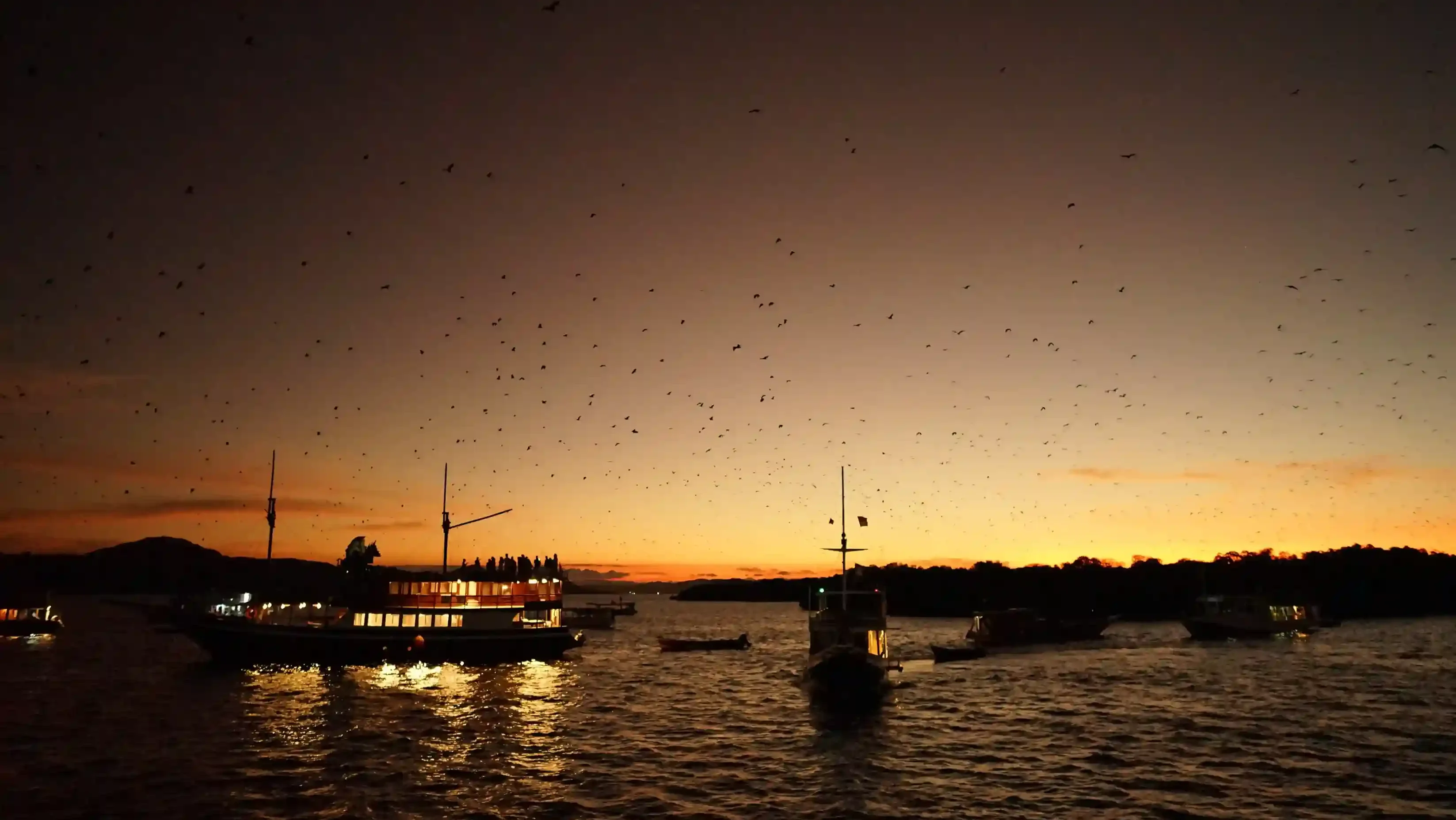
Kalong Island is a mangrove island in Komodo National Park where a large colony of flying foxes – fruit bats – leaves at dusk to feed on Flores. Boats anchor offshore and watch the exodus from the deck. It lasts roughly 20 to 40 minutes and cannot be seen on a day trip.
What actually happens at Kalong?
Kalong – the name simply means flying fox in Indonesian – is a low, dense mangrove island east of Komodo. Through the day the colony roosts in the mangroves, largely invisible from the water except as movement in the canopy. As the light goes, they leave in waves, streaming out over the channel toward the fruiting trees on mainland Flores, and return before dawn.
These are large fruit bats, not the small insect-eating bats most people picture. They have long wingspans, they fly with a slow deliberate beat, and in silhouette against a coloured sky the effect is closer to birds than to anything nocturnal. There is no shrieking swarm and nothing unsettling about it. It is quiet, and it goes on for longer than you expect.
Why do you watch from the boat?
Because there is no landing. Kalong is mangrove, not beach, and the colony is the reason the stop exists – boats anchor off and stay off. That is not a restriction imposed on the experience; it is the experience. You are on the top deck with a drink as the light goes, the engines are off, and the bats come to you.
It is also the single clearest illustration of why an overnight trip is a different product from a day tour. Day boats have to be back in Labuan Bajo harbour before dark, which means they are already heading home while this is happening. Overnight boats anchor here for the night. The same asymmetry works in reverse at dawn, which we cover in the Padar sunrise hike guide. On our standard route Kalong closes the first evening, as set out on the 3D2N itinerary and price page.
| Roughly when | What is happening |
|---|---|
| 16:30–17:30 | Boat repositions and anchors off the mangroves; last swim or shower |
| 17:15–17:45 | Crew set up on the sundeck; light starts to go warm |
| Around sunset | First groups lift out of the canopy – the exodus builds in waves |
| 20–40 minutes after first movement | Peak flow across the channel toward Flores |
| After dark | Dinner on board, then the first night at anchor |
Sunset in this part of Indonesia falls roughly between 17:30 and 18:15 depending on the time of year. Your crew will tell you the actual time on the day – the bats do not run to a published schedule.
How do you photograph it?
This is a genuinely hard shot: small moving subjects, falling light and a deck that is never completely still. Phone cameras struggle. If you are carrying a proper camera, the settings that work are the ones that prioritise shutter speed and accept noise:
- Shutter at 1/500 or faster if you want the wings sharp; slower reads as motion blur
- Open the aperture as far as the lens allows and let ISO float upward – noise is recoverable, motion blur is not
- Expose for the sky, not the bats. You are making silhouettes; that is the strong image anyway
- Brace against the rail rather than holding the camera free, and shoot in bursts
- A moderate telephoto beats a long one, because you want sky and mangrove context in frame
Drone footage of the exodus is a common request and a common misunderstanding. Flying inside the park requires written permission from the park authority plus a permit fee, and flying at a roosting colony is exactly the sort of use that gets refused. Our own exclusions list quotes the drone permit at approximately IDR 2.1 million per unit per day; the wider picture is set out in our Komodo photography and drone permit guide.
Why does the colony matter beyond the spectacle?
Flying foxes are long-distance seed dispersers and pollinators. The colony crossing to Flores every night is doing measurable ecological work on the forests over there, which is a more interesting reason to protect a mangrove island than tourism revenue. It is also why the no-landing convention is worth respecting without complaint – roost disturbance is the thing that breaks a colony.
What else happens that evening on board?
Kalong marks the handover from the moving part of the day to the still part. Once the light goes the boat stays at anchor, dinner is served, and the deck becomes the place people actually talk to each other. On a boat with no light pollution for miles, the star field on a clear night is the second show of the evening and nobody warns you about it either.
The full shape of an evening at anchor – dinner, the lounge, sleeping to the sound of water on a hull – is described in a day in the life on board. If you want to see how that sits inside a complete package, our luxury Komodo cruise page covers the vessel and what is included, and you can browse overnight Komodo sailings more widely to compare how other boats handle the same anchorage.
Frequently asked questions
What are the bats at Kalong Island in Komodo?
They are flying foxes – large fruit bats. They roost in the mangroves through the day and leave at dusk to feed on fruiting trees on mainland Flores, returning before dawn.
Can you land on Kalong Island?
No. It is mangrove rather than beach, and the colony is the reason for the stop. Boats anchor offshore and guests watch from the deck, which keeps the roost undisturbed.
How long does the flying fox exodus last?
Usually around 20 to 40 minutes from the first groups lifting off, building in waves. The exact timing follows the light rather than a clock.
Can you see Kalong Island on a day trip from Labuan Bajo?
Realistically no. Day boats must return to Labuan Bajo before dark, so they are already sailing home when the exodus begins. It is an overnight-only experience.
Do the flying foxes come near the boat?
Some pass overhead, which is part of the appeal. They are fruit eaters with no interest in people and there is nothing to be nervous about.
Talk to the people who sail this route
The Kalong evening is the part of the trip guests talk about afterwards and almost nobody books for. Ask us which night of your route it falls on.
WhatsApp: +62 811 3823 875
Email: sales@komodoluxury.com
Neptune Cruise is a 40-metre, seven-cabin phinisi operated by Komodo Luxury out of Labuan Bajo, Flores. Send us your dates, how many people are travelling, any dietary requirements and whether anyone in the party dives, and you will get availability and a written quote back – not a brochure.
