
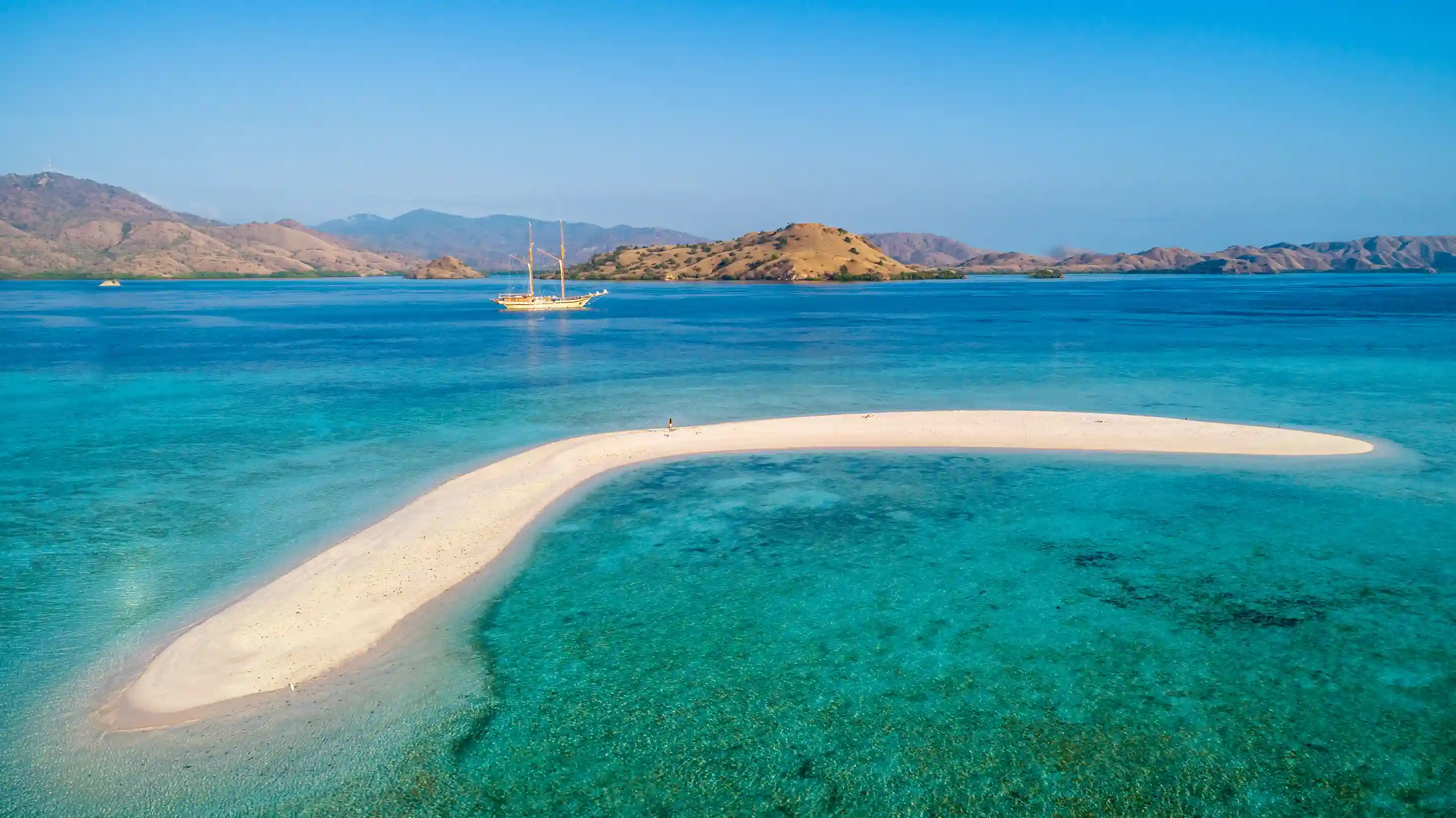
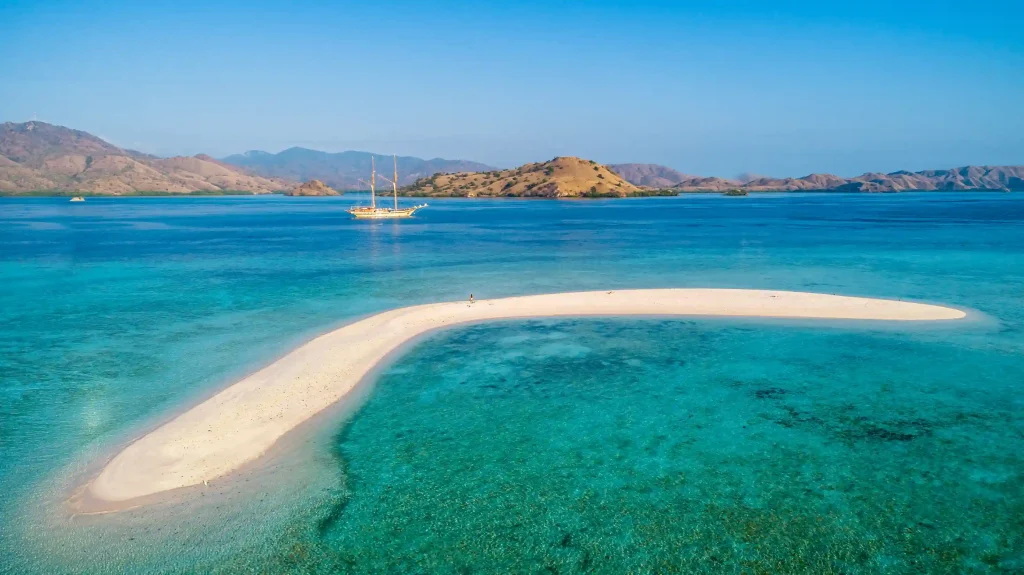
Taka Makassar is a small crescent-shaped sandbar in the middle of Komodo National Park with no shade, no facilities and no permanent vegetation. Its size depends entirely on the tide – at high water much of it is submerged. Boats visit for 30 to 60 minutes, usually straight after Manta Point.
What is Taka Makassar actually?
It is a bank of white coral sand sitting on a shallow reef platform, curved like a comma, surrounded by water so clear and so shallow that the whole thing photographs as a bright turquoise halo. There is nothing on it. No trees, no shelter, no toilet, no drinking water, no one selling anything. That emptiness is the entire point of the stop.
The name uses taka, a local word for a submerged reef or shoal, which tells you something important: this is a reef feature first and a beach second. It exists at the pleasure of the tide.
How much does the tide change it?
Substantially. At low water the bar is a proper walkable strip of sand. At high water a large part of it is under a few centimetres of sea, and on a high spring tide you may find little more than a wet ridge you stand ankle-deep on. Neither version is a failed visit – the shallow, flooded version is arguably the more striking one to photograph – but it does mean the sandbar you saw in a photograph is not necessarily the sandbar you will stand on.
| Tide state | What you get | Best for |
|---|---|---|
| Low | Maximum exposed sand, widest crescent, easy walking | Walking the bar, group photographs, drone-style wide framing |
| Mid | A clear strip of sand with shallow water lapping both sides | The classic look; usually the most photogenic compromise |
| High | Much of the bar submerged under shallow water | Wading shots, colour saturation, snorkelling the edges |
| High spring | Only a narrow wet ridge, sometimes none | Still worth the swim; manage expectations |
Nobody can promise you a specific tide state on a specific day – the tide table sets it, not the itinerary. A crew that knows the area will try to time the visit sensibly around the manta drift and the rest of the day, but the sea gets the final vote.
Why is it always paired with Manta Point?
Because it is roughly 15 to 30 minutes away by boat from Karang Makassar, and because the two stops balance each other. Manta Point is a drift snorkel in moving water where you are concentrating; Taka Makassar is standing in warm shallows doing nothing. Doing the hard one first and the easy one second is how the day is normally built.
The manta drift itself, and how we run entries and pickups there, is described on our Komodo snorkelling cruise page, and the odds of a good encounter by month are broken down in our month-by-month manta guide.
What is the snorkelling like off the edges?
Easy, bright and shallow – a good site for people still building confidence. The reef platform drops away from the sand in stages, so you can float over coral in waist-deep water and swim out to a proper slope if you want to. Because the water is shallow and the sand is white, the light is exceptional and colours read strongly even without a camera.
- Watch the current at the tips of the crescent – the water accelerates around the ends even when it looks calm in the middle
- Do not stand on coral. The shallow platform makes this an easy mistake; use fins and float
- Boat traffic is the real hazard here, not marine life. Stay inside the area the crew marks
How do you survive a shadeless sandbar?
Every part of this stop is exposed. There is no tree, no rock and no shelter, the sand is highly reflective, and people routinely get their worst sunburn of the whole trip here in under an hour because the breeze makes it feel mild.
- Reef-safe sunscreen applied on the boat before you land, not on the sand
- A long-sleeve rash guard is more reliable than reapplying cream while wet
- Hat and sunglasses; the glare off white sand and shallow water is severe
- Take water ashore – there is none there
- Keep the visit to what the crew suggests rather than stretching it
This is one of several stops where the difference between a good day and a miserable evening is entirely down to what came out of your bag, which is why we send the same packing list to every guest before departure.
What are the rules on the sandbar?
Take nothing and leave nothing. Sand, coral fragments and shells stay where they are – removing them from the national park is prohibited. Rubbish goes back to the boat, including anything you find that someone else left. Drones may only be flown inside the park with written permission from the park authority and a paid permit, and landing one on the bar is a good way to lose it to a wave.
Park charges for snorkelling and entry apply here as everywhere else in the park and are paid separately from your cruise fare in cash; how that works, and why we refuse to publish an invented tariff, is set out in our park fees and permits explainer.
Which itineraries include it?
Taka Makassar sits on the standard three-night central circuit as part of the second full day, after Padar, Pink Beach, the dragon trek and Manta Point. Two-night routes sometimes drop it when the schedule tightens. The full day-by-day sequence is on our 3D2N itinerary and price page, and longer routes that push north and add dive days are covered on the 4D3N extended itinerary. If you want to see how widely it appears, it is worth scanning routes that include Taka Makassar across the wider Labuan Bajo fleet.
Frequently asked questions
Is Taka Makassar always above water?
No. It is a tidal sandbar. At low water it is a wide walkable crescent; at high water much of it is submerged under shallow sea, and on a high spring tide there may be only a narrow wet ridge.
How long do boats stop at Taka Makassar?
Typically 30 to 60 minutes, usually straight after the drift snorkel at Manta Point, which is roughly 15 to 30 minutes away.
Is the snorkelling good at Taka Makassar?
Yes, and it is easy. The reef platform is shallow and bright with good coral off the edges, which makes it one of the friendlier sites for less confident swimmers. Current picks up at the tips of the crescent.
Can you stay overnight or camp on Taka Makassar?
No. It has no facilities, no shade and no fresh water, it floods with the tide, and it sits inside a national park. Boats anchor elsewhere for the night.
Can you take sand from Taka Makassar?
No. Removing sand, coral or shells from Komodo National Park is prohibited.
Talk to the people who sail this route
Tides decide what Taka Makassar looks like on your day. Send us your travel window and we will tell you what the water is likely to be doing.
WhatsApp: +62 811 3823 875
Email: sales@komodoluxury.com
Neptune Cruise is a 40-metre, seven-cabin phinisi operated by Komodo Luxury out of Labuan Bajo, Flores. Send us your dates, how many people are travelling, any dietary requirements and whether anyone in the party dives, and you will get availability and a written quote back – not a brochure.
