
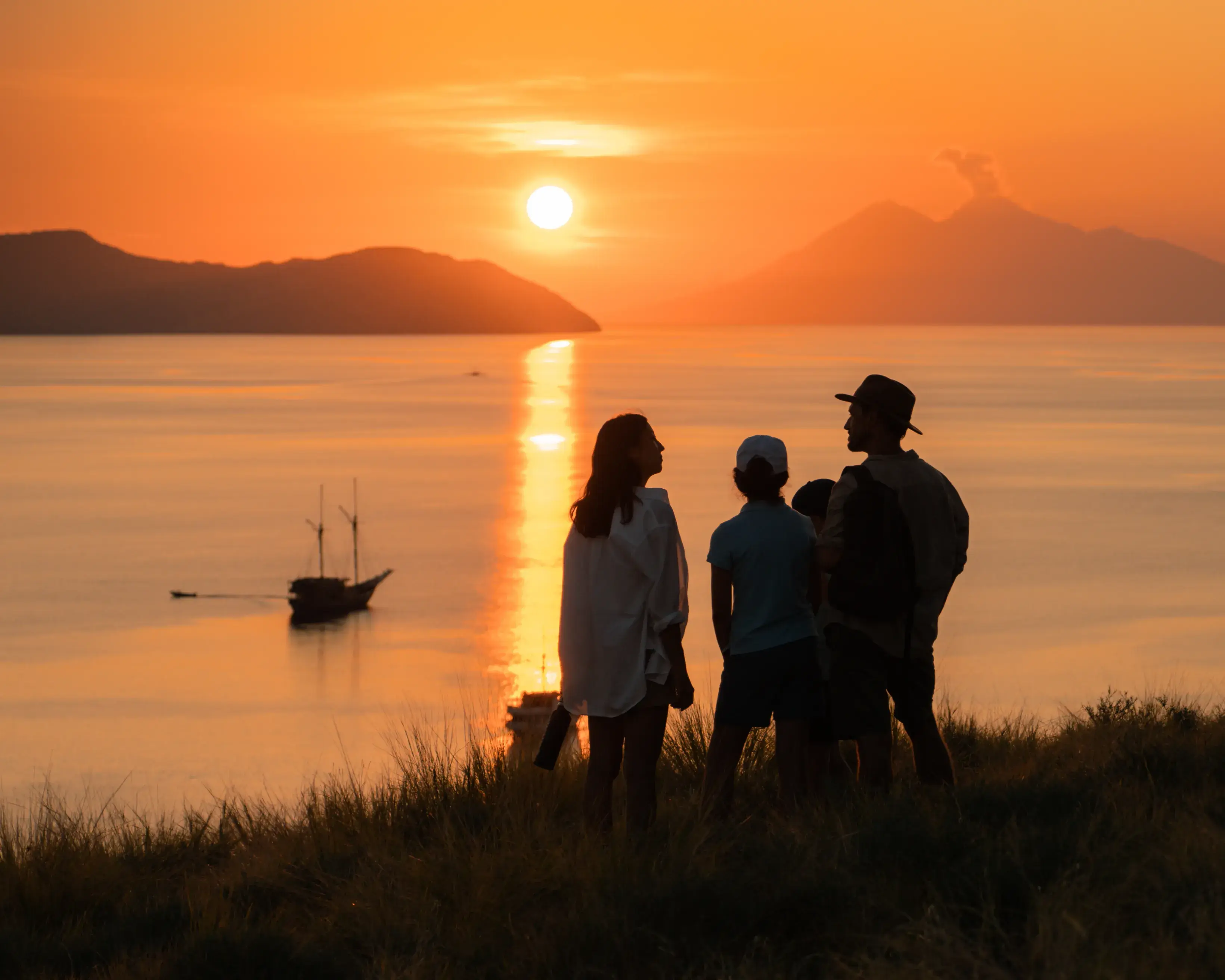
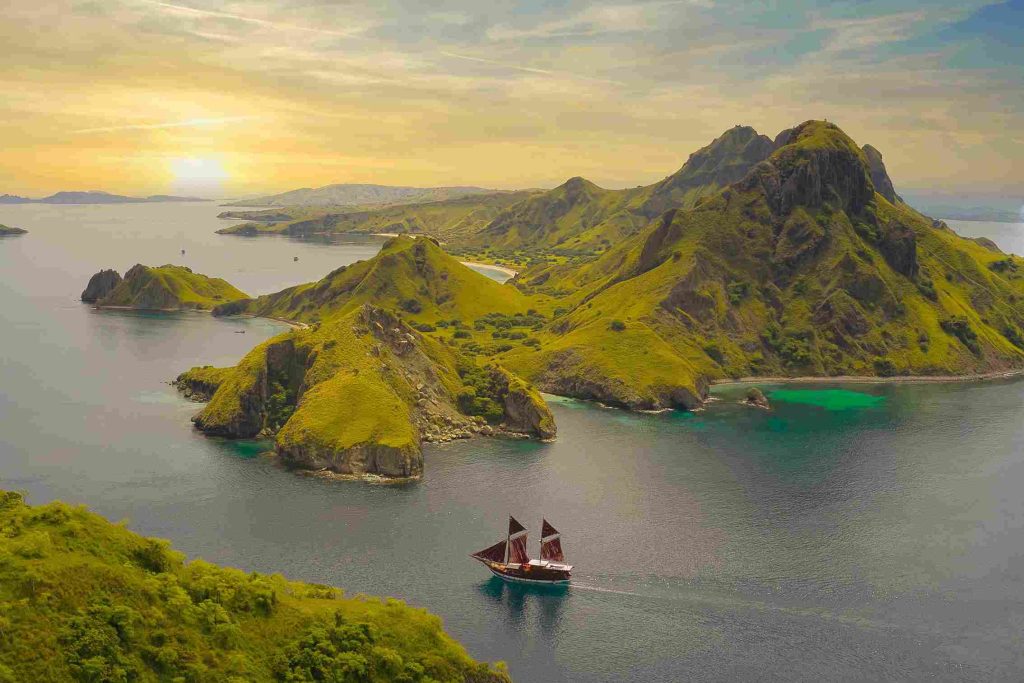
The best light in Komodo is at Padar before sunrise, at Kalong at dusk and over Taka Makassar at midday. Flying a drone inside the national park requires written permission from the park authority plus a permit fee – our own exclusions list quotes approximately IDR 2.1 million per unit per day.
Where does the light actually work?
Komodo is a hard place to shoot badly and a hard place to shoot well, because the same equatorial sun that makes the water turquoise flattens everything between about 10:00 and 15:00. The trip’s photographic value is concentrated in a few specific windows:
| Where | When | What you are shooting |
|---|---|---|
| Padar ridge | 20–40 minutes before sunrise | Layered ridgelines, three bays, silhouetted walkers on the spine |
| Padar lower shoulder | Sunrise to 30 minutes after | Side light raking across the hills; texture the pre-dawn light does not show |
| Pink Beach | 07:00–09:00 or after 15:30 | The pink cast only reads in warm low-angle light |
| Taka Makassar | Midday | The one time harsh overhead sun helps – it saturates the shallow turquoise |
| Manta Point | Whenever the current runs | Underwater, ambient light only. Tide dictates, not the clock |
| Kalong Island | The 30 minutes around sunset | Flying foxes as silhouettes against a coloured sky |
| The boat at anchor | Blue hour and after dark | Warm deck lights against a violet sky; long exposure from the tender |
What is the drone situation, honestly?
This is the part that catches people out, so it is worth stating without hedging. Flying a drone inside Komodo National Park is not a matter of taking off from the sundeck because nobody is watching. It requires written permission from the park authority, and a permit fee is charged on top. Our own exclusions list quotes that permit at approximately IDR 2.1 million per unit per day, and it is listed as an exclusion precisely because it is not part of your fare.
Where you must not fly, regardless of paperwork:
- Over Komodo dragons or along the ranger trails – this is wildlife harassment and it is the fastest way to have equipment confiscated
- Over ranger stations and park infrastructure
- Over the roosting colony at Kalong – disturbing a roost is exactly the use case permits exist to prevent
- Over crowds of people, including the Padar ridge at sunrise
- Low over mantas, which scatters them and ruins the encounter for everyone in the water
The park fee structure more broadly, including camera permits, is explained in our guide to Komodo National Park fees and permits – including why we refuse to publish an invented tariff table for the other components.
How do you shoot Padar without taking the same photo as everyone else?
The frame from the main viewpoint with three bays fanning below is the reason people climb, and it is worth taking. Then move. Three alternatives that consistently produce stronger images:
- Shoot back up the ridge from the shoulder below. A line of walkers silhouetted on a spine against a pink sky beats another empty landscape
- Wait 20 minutes after the crowd leaves. Side light at 06:30 shows the texture of the hills; the pre-dawn light does not
- Shoot the boats. From the ridge, phinisi at anchor in the bay below at first light is the shot that actually says Komodo
The practical detail – wake-up time, how long the climb takes, whether you can carry a tripod up – is in the Padar sunrise hike guide. Short answer on the tripod: you can, and almost nobody needs one.
How do you photograph mantas without harassing them?
The behaviour that gets you good images is the same behaviour that protects the animals. Mantas approach calm, still people and leave people who chase them.
- Stay on the surface or to the side of the animal’s path; never swim at it or over it
- No flash. It is prohibited at most sites and it does not work at that distance anyway
- Shoot upward with the surface in frame – sunlight through water gives you the separation a flat side-on shot lacks
- Wide lens, get closer by waiting rather than by swimming
- Set exposure before you enter the water; there is no time to fiddle in a drift
The site itself, and when the current makes it work, is covered on our Komodo snorkelling cruise page and in the month-by-month manta guide.
What survives salt, spray and a moving deck?
- A dry bag for every transfer. The tender will splash. This is not optional
- Rinse and dry gear daily – salt destroys more equipment on liveaboards than water does
- Spare batteries and cards. There is nowhere to buy either between Labuan Bajo and the end of your trip
- Fast shutter over sharp aperture on a moving deck – a stopped-down landscape at 1/60 from a rolling boat is a soft landscape
- Lens cloths, plural. Salt haze on the front element is the invisible problem you find at home
What does the crew already shoot for you?
Documentation is included in the fare: drone, GoPro and mirrorless coverage by the crew through the trip. Two things follow from that. First, you do not need to bring a full kit to come home with good images. Second, and more usefully, you can put the camera down at the sites where you would otherwise spend the whole encounter behind it – which, on the evidence of most guests, is the manta drift.
What is included alongside the documentation is set out on our luxury Komodo cruise page and in full on the rates page. If image-making is the actual purpose of your trip, it is worth comparing photography-friendly departures across operators, because schedules built around light are noticeably different from schedules built around convenience.
Frequently asked questions
Can you fly a drone in Komodo National Park?
Only with written permission from the park authority and a paid permit. Our exclusions list quotes the drone permit at approximately IDR 2.1 million per unit per day. Flying over dragons, ranger stations, the Kalong bat colony, crowds or mantas is not permitted regardless of paperwork.
What is the best time of day to photograph Padar?
The 20 to 40 minutes before sunrise for the classic layered ridgelines, then a second pass around 20 to 30 minutes after sunrise when side light shows the texture of the hills and most of the crowd has left.
Do you need a professional camera for a Komodo cruise?
No. Modern phones handle the dawn and dusk scenes well because the dynamic range is gentle. The gap shows underwater and on wildlife at distance. Crew documentation with drone, GoPro and mirrorless is included in our fares.
Is there a camera fee in Komodo National Park?
Camera and drone permits are among the charge components the park authority applies, separate from your cruise fare and paid in cash. Ask our reservations team for current amounts rather than relying on published figures.
How do you photograph manta rays while snorkelling?
Stay calm and still, let the animal come to you, shoot upward with the surface in frame, use a wide lens and no flash. Never chase or swim over a manta – it ends the encounter for everyone.
Talk to the people who sail this route
If you are coming to shoot rather than to sightsee, say so when you book. It changes where we anchor and what time we wake you.
WhatsApp: +62 811 3823 875
Email: sales@komodoluxury.com
Neptune Cruise is a 40-metre, seven-cabin phinisi operated by Komodo Luxury out of Labuan Bajo, Flores. Send us your dates, how many people are travelling, any dietary requirements and whether anyone in the party dives, and you will get availability and a written quote back – not a brochure.
