
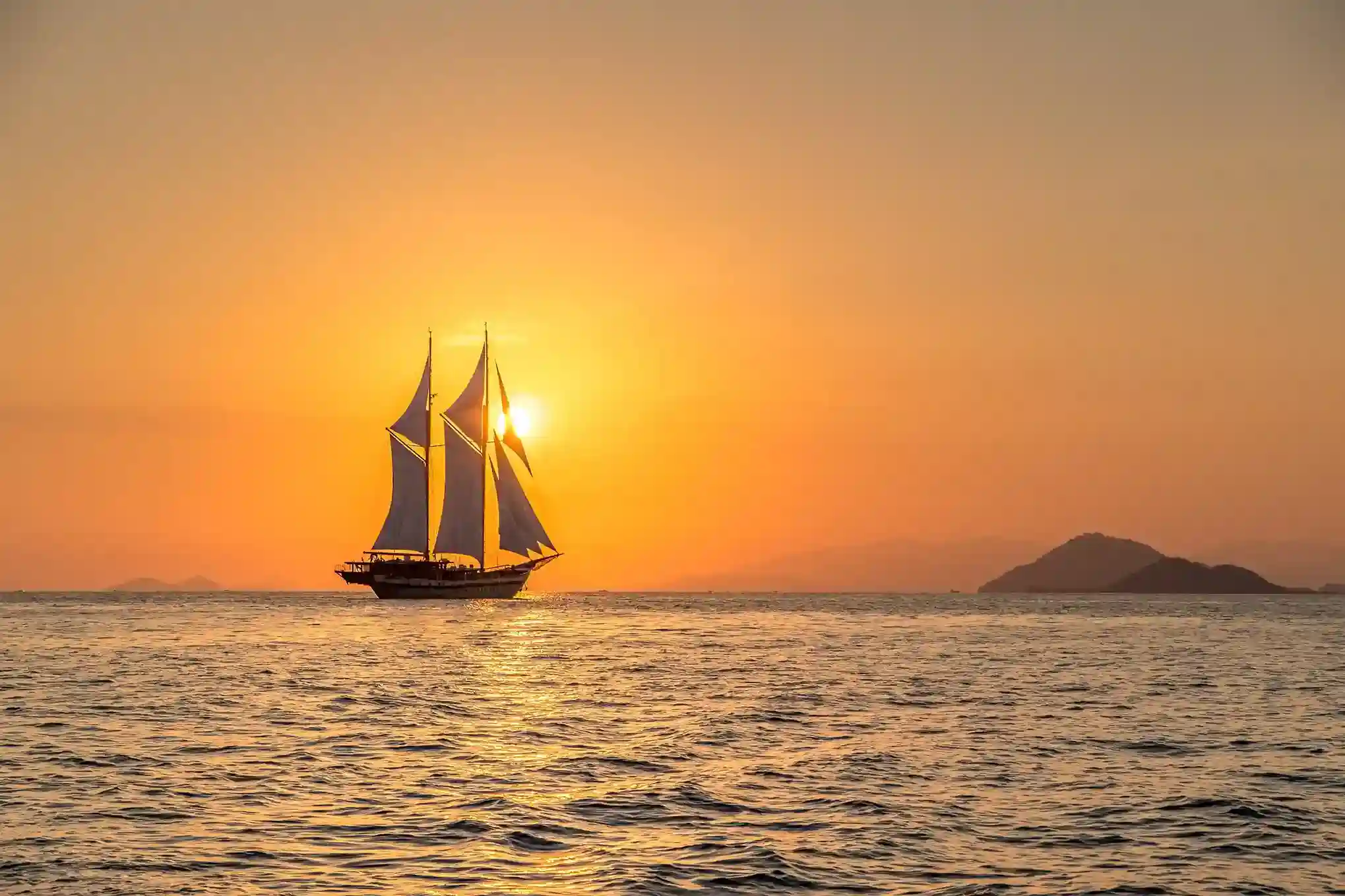
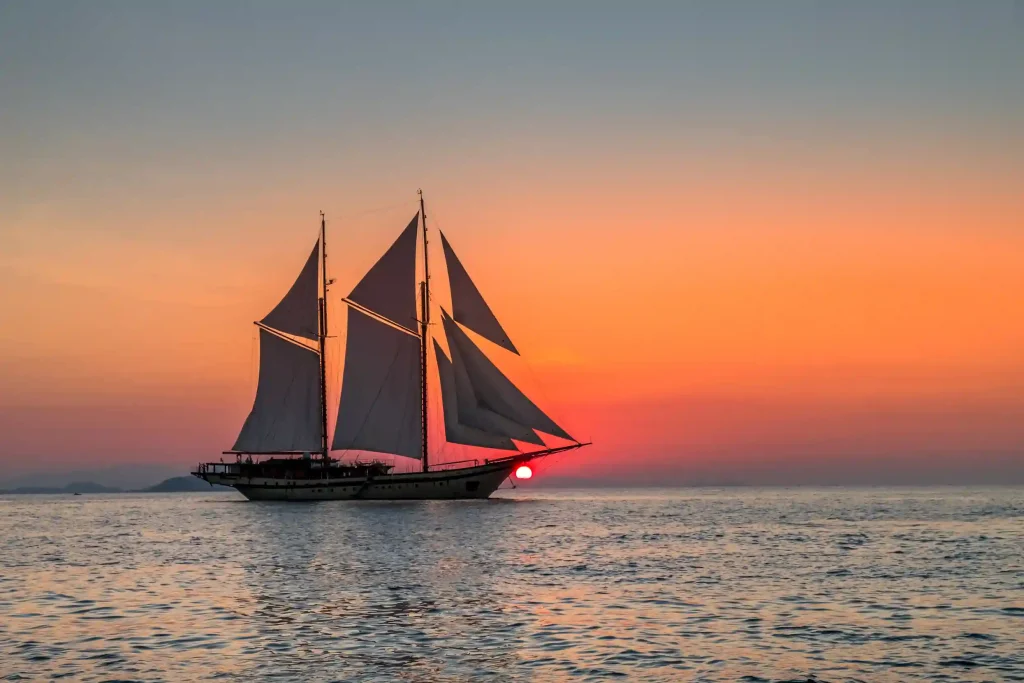
A day on a Komodo phinisi runs on daylight rather than a clock: a pre-dawn wake-up for a sunrise site, breakfast under way, a mid-morning snorkel, lunch and a slow hour, an afternoon site, sunset from the deck, dinner on board and a night at anchor in a sheltered bay. Hull size changes the rhythm more than the schedule does: on the 37-metre Elbark phinisi, nine cabins spread over three decks means the tender queue never really forms.
How does a day on a liveaboard actually start?
Early, and quietly. On a sunrise-site morning the crew wake guests somewhere between 04:30 and 05:00 with coffee already made, and the tender runs ashore in the dark. Nobody is obliged to go. A predictable third of any boat stays in bed, and a smaller group gets up specifically to have the sundeck to themselves while everyone else is on a hill.
The hill in question is usually Padar, and how steep it is and what it looks like at the top is covered in the Padar sunrise hike guide.
| Roughly | What is happening |
|---|---|
| 04:30–05:00 | Wake-up, coffee, tender ashore for a sunrise site |
| 06:30–07:30 | Back on board; breakfast on the sundeck as the boat gets under way |
| 08:30–10:30 | Sail to the morning site; snorkel or dive; gear rinsed and hung |
| 11:00–12:00 | A land stop – a beach, or a ranger-guided trail |
| 12:30–13:30 | Lunch on board, usually while moving |
| 13:30–15:00 | The flat hour. Nobody schedules anything. People sleep, read, sit |
| 15:00–17:00 | Afternoon site – the second snorkel, often the best light |
| 17:00–18:15 | Reposition to the night anchorage; showers; sunset from the deck |
| 19:00–20:30 | Dinner in the dining room or outside |
| 20:30 onwards | Lounge, bar, karaoke, or the deck and the stars |
This is a shape, not a timetable. Tides, wind and what the crew see on the day move everything, and a good crew moves it rather than sticking to a printed schedule.
What is the snorkel routine like?
Repetitive in a good way. Gear lives in a set place and stays yours for the trip; you kit up on the dive deck, the tender takes groups out in batches, the crew brief the entry and the pick-up point, and someone is always in the water or watching from the tender. Coming back, everything gets rinsed and hung, which is why your mask still works on day three.
Sites vary enormously in difficulty over the same trip – a shallow, still coral garden on the first afternoon, a fast drift at Manta Point on the second day. How the harder sites are run is on our snorkelling cruise page. The boat carries a dive deck and snorkel gear and is genuinely dive-friendly, but to be clear about what that means: it is a phinisi with a dive deck, not a dive centre, and dives are arranged with licensed dive operators rather than run by in-house instructors.
What is the food like?
Full board, cooked on board, served buffet-style or plated depending on the meal, and generally Indonesian with international dishes alongside. Grilled fish, rice, vegetables, sambals, fruit at every meal, and consistently more of it than people expect. Mineral water, coffee and tea are included throughout; alcohol and soft drinks are not.
Dietary requirements are handled if you give notice at booking rather than at the harbour. Vegetarian, vegan, no pork, allergies – all workable, none of it improvisable once the provisioning run has been done and the boat is three hours from a shop.
Why does everyone talk about the hour after lunch?
Because it is the part of a liveaboard that does not exist on a land holiday. There is no activity, no wifi worth using, nowhere to walk to and nothing to organise. The boat is moving, the deck is shaded, and for about ninety minutes a group of adults who arrived stressed do nothing at all.
Guests routinely nominate this – not Padar, not the mantas – as the thing they would come back for. It is also the strongest practical argument for an overnight boat over a day tour, which is the same argument made from a different angle in how many days you need in Komodo.
What happens in the evening?
Sunset is watched from the sundeck, most often at anchor. On the first night of the standard route that means Kalong and the flying-fox exodus, described in our Kalong Island sunset guide. After dinner the boat has a bar and a karaoke lounge, which some groups use enthusiastically and others ignore entirely in favour of lying on the deck looking at a sky with no light pollution in it.
There is a real social dynamic on a shared trip: seven cabins, up to twenty people, three days. It works well far more often than not, but it is not for everyone, which is why families and groups frequently take the whole boat – the case for that is on our private phinisi charter page.
What is it like sleeping at anchor?
Better than most people expect. The boat stops moving in any meaningful way once the anchor is down in a sheltered bay, cabins are air-conditioned and en-suite, and the background sound is water against a wooden hull. The generator runs, and you will hear it – it is the price of air conditioning and hot showers on a boat two hours from the nearest grid connection.
Charging happens in cabins and communal areas, and the boat carries satellite Wi-Fi, which much of the Komodo fleet does not; treat it as messaging-grade, as explained in our connectivity guide. If you want to see how other boats run their days, comparing daily schedules across operators tells you more about a trip than any photograph will.
Frequently asked questions
What do you actually do all day on a Komodo liveaboard?
Roughly two water stops and one or two land stops per day, spaced by sailing legs. Between them you eat, sleep, sit on deck and do nothing, which is a larger and more valued part of the trip than the brochure suggests.
Is the food included on a Komodo liveaboard?
Yes. All meals, mineral water, coffee and tea are included on our cruises. Alcoholic and soft drinks are not. Dietary requirements are catered for if you tell us at booking.
Do you have to get up for the sunrise hikes?
No. The crew wake everyone who asked to be woken and the rest sleep. Plenty of guests skip one sunrise and do the other.
Is there air conditioning and hot water on board?
Yes, in all seven cabins, all of which are en-suite with hot showers. The generator that makes this possible is audible at night.
What is the social side like on a shared trip?
Up to twenty guests across seven cabins, eating together and diving or snorkelling in groups. It is sociable by design. Groups and families who want the boat to run on their own schedule generally take a private charter instead.
Talk to the people who sail this route
Every boat sells the same islands. What differs is how the day is run. Ask us for the actual schedule we would sail on your dates.
WhatsApp: +62 811 3823 875
Email: sales@komodoluxury.com
Neptune Cruise is a 40-metre, seven-cabin phinisi operated by Komodo Luxury out of Labuan Bajo, Flores. Send us your dates, how many people are travelling, any dietary requirements and whether anyone in the party dives, and you will get availability and a written quote back – not a brochure.
